Industry Knowledge
2026-09-15 15:59:49
To distinguish them from autogenous mills, grinding mills that require the addition of metallic grinding media (balls or rods)—such as ball mills and rod mills—are generally referred to as "conventional grinding mills." To achieve high grinding efficiency and improve the economic outcomes of mineral processing, it is essential to select the appropriate type of mill based on the specific requirements for feed particle size, the characteristics of the raw ore, and the inherent features of each mill type. The primary characteristics and application ranges of the ball and rod mills commonly used in mineral processing plants are as follows: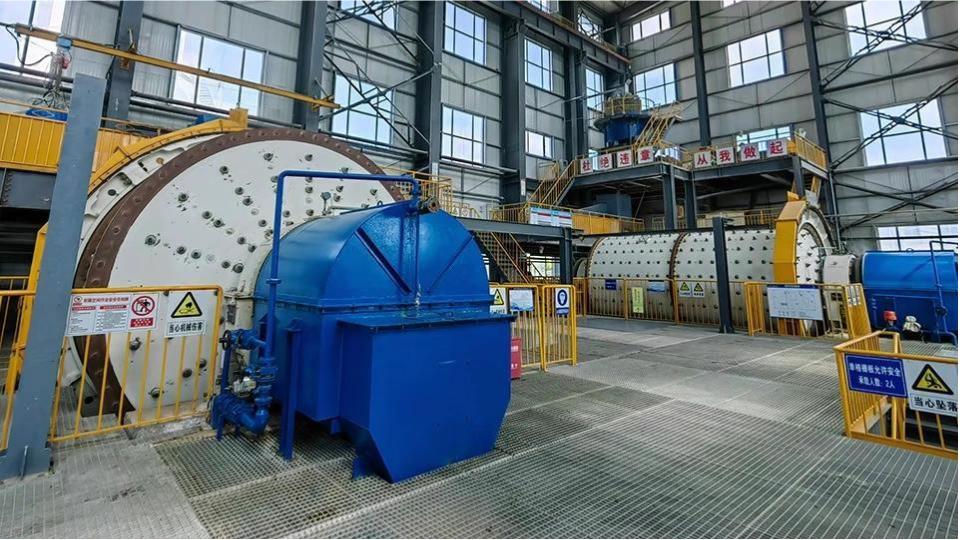
(1) Grate-discharge ball mill: Equipped with a specialized grate plate and internal lifters (within sectoral compartments), this mill facilitates forced, low-level discharge. Ground particles are prevented from remaining in the mill for an excessive duration and are discharged promptly. This minimizes over-grinding, results in faster grinding rates, and ensures high efficiency.
(2) Overflow-type ball mill: In this design, the hollow trunnion at the discharge end has a slightly larger diameter than the one at the feed end. This creates a gradient in the pulp level, causing it to slope toward the discharge end. Once the pulp level exceeds the lowest point of the discharge opening's inner diameter, the material overflows. This is a non-forced, high-level discharge process characterized by a slower discharge rate and longer residence time for the ore within the mill. Consequently, the grinding media are less effectively utilized, leading to significant over-grinding. Furthermore, the throughput of an overflow-type mill is lower than that of a grate-discharge mill of the same size. These mills are typically used for fine grinding or as the second stage in a two-stage grinding circuit.
(3) Rod mill: This mill utilizes steel rods as grinding media. As the rods fall horizontally, they make line contact with the ore, resulting in selective comminution (i.e., ore is broken down progressively from the largest particles to the smallest). This minimizes over-grinding and produces a uniform particle size distribution. Rod mills are well-suited for coarse grinding or for use in gravity separation plants where excessive fine grinding (over-grinding) must be avoided.
chat online
Phone
24-Hour Hotline
Inquire Now

TOP