Industry Knowledge
2026-08-19 17:01:51
Magnetic separation is a primary method for beneficiating iron ore. Common iron minerals include magnetite (strongly magnetic), as well as hematite, limonite, specularite, and siderite (weakly magnetic); these serve as raw materials for the iron and steel industry. Since iron ores in my country generally have low grades and high impurity content, over 80% of them require magnetic separation.
Manganese minerals—such as psilomelane, pyrolusite, and rhodochrosite—are also weakly magnetic and are commonly recovered using magnetic separation.
Ilmenite, wolframite, monazite, and niobium-tantalum minerals are also weakly magnetic and are frequently recovered via magnetic separation.
While the examples above focus on recovering magnetic minerals as the target product (i.e., as concentrate), in the processing of non-metallic minerals, iron and titanium impurities are treated as undesirable components and are typically removed using magnetic separation.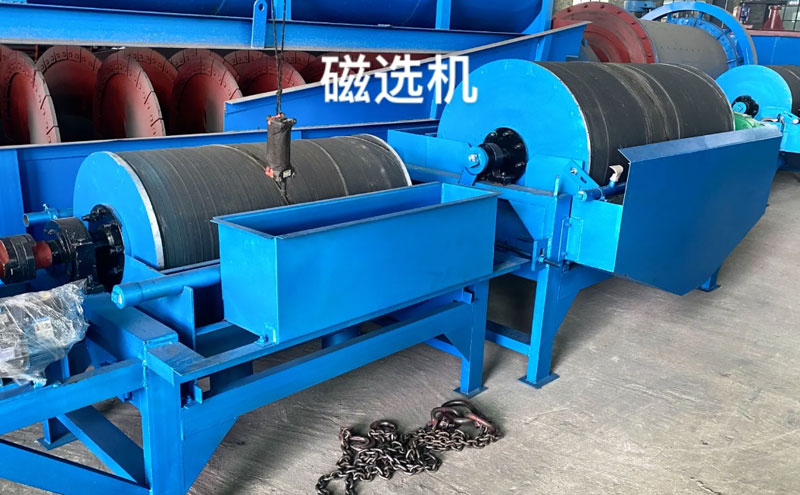
For instance, magnetic separation is commonly used to remove iron and titanium minerals from kaolin, kyanite, quartz, feldspar, and tourmaline.
In dense-medium separation, where ferrosilicon or magnetite serves as the weighting agent, magnetic separation offers a simple and effective method for recovering that agent; this application is frequently seen in coal preparation plants.
During ore crushing, the entry of iron objects into the crushing chamber of fine crushers can cause damage; magnetic separation is commonly employed to remove such iron objects from the feed material.
Magnetic separation also plays a role in the treatment of industrial waste (solid waste, wastewater, and waste gas) by enabling the comprehensive recovery of useful components and protecting the environment. Examples include the recovery of steel slag at steel plants, the processing of fly ash at power plants, and wastewater treatment at steelworks.
Magnetic fluid separation is a novel magnetic separation technique. It utilizes the "apparent weighting" effect generated by a magnetic fluid within a magnetic field; this creates a significant magnetic buoyant force on objects immersed in the fluid, allowing for the separation of materials based on density differences. Countries such as the United States and Japan employ the magnetic fluid separation method to process automotive waste, whereas in my country, the technique is primarily used for diamond beneficiation.
chat online
Phone
24-Hour Hotline
Inquire Now

TOP