Industry Knowledge
2026-09-04 17:20:57
Titanium-zirconium sand deposits primarily occur as coastal placer deposits, followed by inland placer deposits. These deposits are formed through the natural weathering, fragmentation, and enrichment of primary ores. They offer advantages such as ease of mining and beneficiation, low production costs, high product quality, a wide variety of associated minerals, and significant value for comprehensive recovery. Currently, these sand deposits are the world's primary source of mineral products such as ilmenite, rutile, zircon, and monazite.
With the exception of a few deposits requiring the removal of overburden from the upper sections of the ore body, titanium-zirconium sand deposits generally do not require stripping and can be mined using dry mining machinery or floating dredges. Dry mining equipment includes bulldozers, scrapers, loaders, and bucket-wheel excavators; dredging vessels include bucket-chain, cutter-suction, and bucket-wheel types. The mined ore is transported to the roughing plant via belt conveyors or slurry pipelines. The beneficiation process consists of two stages: roughing and cleaning.
1) Roughing
Ore entering the roughing plant undergoes initial processing—including trash removal, screening, classification, desliming, and thickening—before proceeding to the roughing circuit.
The objective of roughing is to produce a rough concentrate for the cleaning plant. Gravity separation methods are employed to discard low-density gangue minerals based on mineral density, yielding a mixed heavy mineral rough concentrate with a heavy mineral content of approximately 90%.
Roughing plants are typically integrated with mining operations to form a combined mining and beneficiation complex. To suit the characteristics of sand deposits, roughing plants are usually constructed as mobile units. Mobility is achieved through various methods, such as mounting on floating barges, or using land-based rails, crawler tracks, or skids, as well as periodic dismantling and relocation.
Equipment selected for titanium sand roughing typically features high processing capacity and recovery rates, and is suitable for mobile plant applications; cone concentrators and spiral concentrators are most commonly used, while shaking tables are used to a lesser extent. These devices may be used individually or in combination. Single-stage cone concentrators are primarily used in large-scale roughing plants or at sites where the raw ore has a high content of heavy minerals; many plants employ cone concentrators for roughing and spiral concentrators for cleaning, while some smaller plants use spiral concentrators for the roughing stage.
2) Cleaning (Refining)
Titanium-zirconium sand deposits are typically complex ores containing several valuable minerals. The objective of the cleaning stage is to effectively separate and purify the minerals of value found in the rough concentrate, ensuring they meet specific quality standards to become marketable concentrates.
Cleaning plants are generally constructed as stationary facilities. Rough concentrate is transported to the cleaning plant via truck, train, or pipeline. Cleaning operations are categorized into wet and dry processes, with dry processing being the predominant method. However, partial wet processing is often utilized during the initial stages of the cleaning circuit. Occasionally, the process involves alternating between dry and wet cleaning operations; to minimize energy consumption and simplify the process flow, such alternation should be reduced as much as possible.
Wet processing operations in cleaning plants include: gravity separation using shaking tables or spiral concentrators to further discard low-density gangue minerals remaining in the rough concentrate (this also serves to wash away salts from saline rough concentrates); wet magnetic separation to pre-recover easily separable titanium concentrate, thereby reducing the feed volume for subsequent dry separation; high-density agitation with reagents such as sodium hydroxide, hydrochloric acid, dilute hydrofluoric acid, or sodium metabisulfite to remove surface contamination from minerals and improve final concentrate quality; and flotation for the cleaning of zircon and monazite products.
Dry cleaning separates minerals based on differences in properties such as magnetic susceptibility, electrical conductivity, and density. The structure of the dry cleaning process flow varies significantly depending on the composition and properties of the rough concentrate. For rough concentrates with complex mineralogy and a wide range of recoverable minerals, the dry cleaning process is intricate, involving numerous operations and variable flow structures; conversely, for rough concentrates with simple mineralogy, the dry cleaning process is straightforward.
Magnetic separation utilizes various types of magnetic separators with differing field strengths. Magnetic separation relies on differences in magnetic susceptibility among minerals. Common magnetic separation equipment includes disc-type (single, double, or triple-disc), cross-belt, roll-type, and opposing-pole magnetic separators. In dry separation circuits, weak-field magnetic separation is typically employed first to recover highly magnetic magnetite, followed by medium-field magnetic separation to recover the majority of ilmenite, which is moderately magnetic and relatively easy to separate. High-intensity magnetic separation is used to separate weakly magnetic ilmenite and monazite from non-magnetic minerals such as zircon and leucoxene.
Electrostatic separation utilizes differences in electrical conductivity among the minerals present in the rough concentrate. There are three types of electrostatic separators: roll-type, plate-type, and screen-plate type. In dry processing circuits for rough concentrates, electrostatic separation is commonly used to separate conductive minerals from non-conductive ones, to separate rutile from zircon, and to perform final cleaning on minerals such as refractory ilmenite, zircon, and monazite.
In industrial practice, operating conditions—such as magnetic field and electric field strengths—are sometimes varied to alternate between electrostatic and magnetic separation stages, thereby improving separation efficiency.
During dry final separation processes, certain minerals may become co-enriched due to similar electrical or magnetic properties. If there is a sufficient difference in density among these separated minerals, gravity separation is typically employed for further processing. To avoid alternating between dry and wet operations, dry gravity separation methods (such as pneumatic shaking tables) are used for these products. Pneumatic shaking tables are frequently used for the final cleaning of minerals such as zircon, monazite, and altered ilmenite.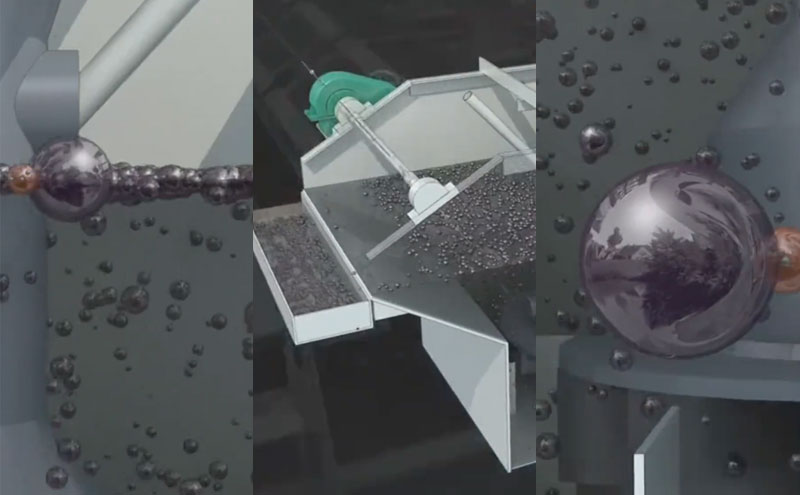
chat online
Phone
24-Hour Hotline
Inquire Now

TOP