Industry Knowledge
2026-10-30 17:14:13
Common malfunctions encountered during the operation of a jaw crusher are summarized below: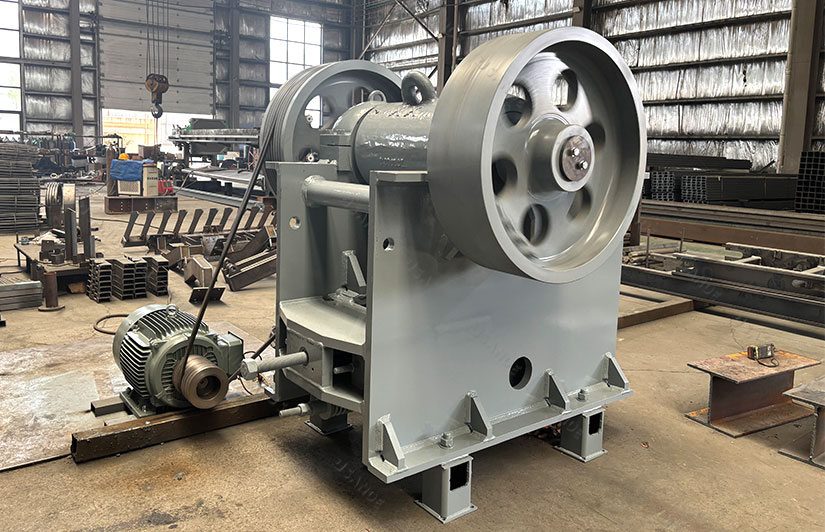
(1) Metallic clanking sounds in the lower section during no-load operation. Such sounds may stem from the following causes: 1) The moving jaw plate and the fixed jaw plate may be striking each other; this is typically due to an excessively small discharge opening and requires immediate adjustment. 2) Clanking may originate from the toggle plate supports or the shim adjustment mechanism. This is generally caused by the loss of elasticity or damage to the tension rod buffer spring, or by the spring being insufficiently tightened, leading to movement. If the connection between the moving jaw, the toggle plate, and the main frame is loose, the toggle plate ends may strike their supports, or the adjustment shims may strike one another; in such cases, the tightening nuts should be adjusted until the clanking ceases. 3) Alternatively, the toggle plate support slider may be severely worn or loose, or the head of the toggle plate itself may be heavily worn; these components should be replaced promptly.
(2) Metallic clanking sounds and vibration of the liner plates during operation. This phenomenon is usually caused by the loosening of the side liner plates or the jaw plates (both moving and fixed), or by the loosening or fracture of the fastening bolts. These parts should be tightened or replaced immediately.
(3) Frequent fracture of the rear toggle plate. In addition to transmitting power, the rear toggle plate is designed to act as a safety mechanism due to its limited structural strength. Beyond the possibility that the toggle plate’s inherent strength is insufficient to withstand the forces generated during normal ore crushing, fractures may also occur if the tension rod spring is tightened excessively; the combined effect of the spring tension and the crushing force can overload the component, causing it to break. In such instances, the spring tension should be appropriately reduced.
(4) The flywheel rotates, but the crusher fails to perform any crushing work. This may be caused by damage to the tension rod or its spring, or by the tension rod nut coming loose, which allows the toggle plate to disengage from the support slide block; alternatively, the toggle plate itself may have fractured and fallen out. In such cases, the components must be replaced and reinstalled.
(5) The flywheel exhibits noticeable wobbling, and the eccentric shaft rotates sluggishly. This fault is caused by a loose or damaged key between the pulley and the flywheel, which prevents the wheel and the shaft from rotating in synchronization.
(6) The particle size of the crushed product becomes coarser; this is the result of severe wear on the lower section of the crushing liner (jaw plate). The liner should be inverted (swapping the top and bottom positions) or replaced with a new one, and the discharge opening must be adjusted to achieve the required product size.
chat online
Phone
24-Hour Hotline
Inquire Now

TOP