Industry Knowledge
2026-10-16 17:02:18
During no-load test run:
(1) When the jaw crusher operates continuously for 2 hours, the bearing temperature rise shall not exceed 30°C.
(2) All fasteners of the jaw crusher should be firm and not loose.
(3) The flywheel and groove wheel run smoothly.
(4) All friction parts of the jaw crusher are free from scratches, chipping and grinding, and there are no abnormal sounds.
(5) The adjustment device of the discharge port of the jaw crusher should be able to ensure the adjustment range of the discharge port.
During loaded test run:
(1) The crusher must not make periodic or significant impact or impact sounds.
(2) The large feed particle size should comply with the design requirements.
(3) After continuous operation for 8 hours, the bearing temperature rise shall not exceed 30°C.
(4) The crusher processing capacity and product particle size should comply with the design requirements.
(5) There is no obvious movement between the adjustment seat and the frame ear seat. 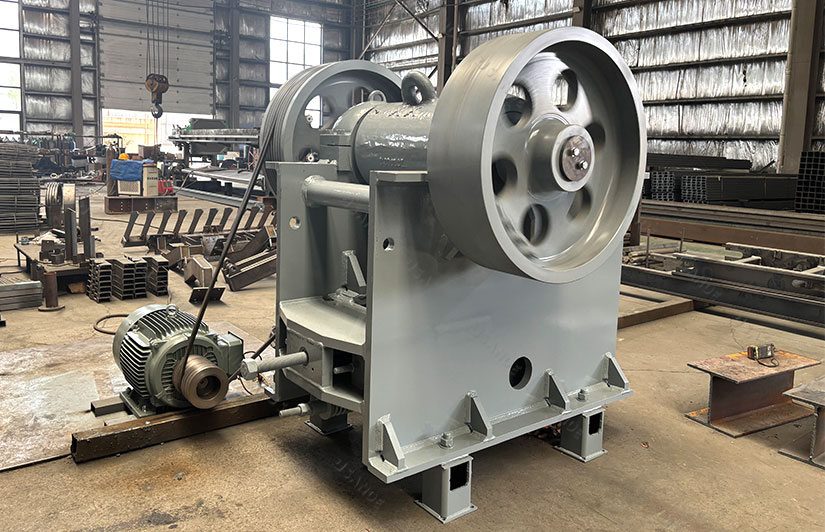
Preparation before use:
(1) Carefully check whether there is enough grease at the joint of the thrust plate.
(2) Carefully check whether all fasteners are tight.
(3) Carefully check whether the transmission belt is in good condition. If any unsafe phenomenon is found, replace it in time. When there is oil stain on the transmission belt or pulley, use a rag to wipe off the oil stain.
(4) Check whether the protective device is in good condition. If any unsafe phenomenon is found, it should be eliminated in time.
(5) Check whether there are ores or debris in the crushing cavity. If there are ores or debris, they must be cleaned to ensure that the crusher cavity is started.
(6) Check whether the jacking bolts are retracted, whether the gasket set is pressed tightly, and whether the T-bolts are tightened.
Startup of jaw crusher:
(1) After inspection, it is proved that all parts of the machine are in normal condition before starting.
(2) The jaw crusher is only allowed to be started without load.
(3) Before starting, a bell or signal must be used to warn in advance.
(4) After starting, if any abnormality is found, the operation should be stopped immediately. The crusher can be restarted only after abnormal conditions have been identified and eliminated.
During production and use:
(1) Only after the jaw crusher is in normal operation can it be put into production.
(2) The materials to be crushed should be evenly added into the crusher cavity, and side feeding or full pile feeding should be avoided to avoid overloading or overloading on one side.
(3) During normal operation, the temperature rise of the bearing should not exceed 30°C, and the maximum temperature should not exceed 70°C. When the above temperature is exceeded, the vehicle should be stopped immediately to find out the cause and eliminate it.
(4) Before stopping, the feeding should be stopped first, and the power can be turned off only after the material in the crushing cavity is completely discharged.
(5) During crushing, if the machine stops due to material obstruction in the crushing cavity, the power should be turned off immediately to stop operation, and the materials in the crushing cavity should be cleaned before restarting;
(6) After one end of the jaw plate is worn, it can be turned around for use.
(7) After the jaw crusher has been used for a period of time, the tightening bushing should be re-tightened to prevent the tightening bushing from loosening and damaging the machine.
chat online
Phone
24-Hour Hotline
Inquire Now

TOP